Skip to content
Menu

Best Sellers

Boomstick Trio

Boomstick Trio®

View Product
Boomsilk

Boomsilk®

View Product
Boom Awaken

Boom Awaken

View Product
Boomstick Color

Boomstick Color®

View Product
Boom Nectar

Boom Nectar®

View Product
Boomstick Rose Nude

Boomstick Rose Nude™

View Product
  • Boomsticks
    • Boomsticks
    • Heritage Boomsticks
  • Makeup
  • Skincare
  • Haircare
  • Tools
  • Reviews
  • Contact
  • Reviews
  • FAQ
  • About
Log in
  • Facebook
  • Instagram
  • TikTok
  • YouTube
BOOM! BeautyBOOM! Beauty
  • Shop
    • Boomsticks
    • Heritage Boomsticks
    • Skincare
    • Makeup
    • Tools
    • Haircare
    • Best Sellers
    • Shop All
  • Bundles
  • Blog
  • About Us
  • Reviews
Menu

Best Sellers

Boomstick Trio

Boomstick Trio®

View Product
Boomsilk

Boomsilk®

View Product
Boom Awaken

Boom Awaken

View Product
Boomstick Color

Boomstick Color®

View Product
Boom Nectar

Boom Nectar®

View Product
Boomstick Rose Nude

Boomstick Rose Nude™

View Product
  • Boomsticks
    • Boomsticks
    • Heritage Boomsticks
  • Makeup
  • Skincare
  • Haircare
  • Tools
  • Reviews
  • Contact
  • Reviews
  • FAQ
  • About
Log in
  • Facebook
  • Instagram
  • TikTok
  • YouTube
Shop
Search
Log in
Bag
Cart
Best Sellers Boomsticks Heritage Boomsticks Makeup Skincare Haircare Tools

Why We Never Say "Anit-Aging" – And What We Say Instead

Walk into any beauty store and count how many products use the phrase "anti-aging." Give yourself about thirty seconds. You'll run out of fingers before you run out of products. It's been the dominant language of the beauty industry for decades. Boom Beauty banned it over fifteen years ago. This is why.
What "Anti-Aging" Actually Says About You

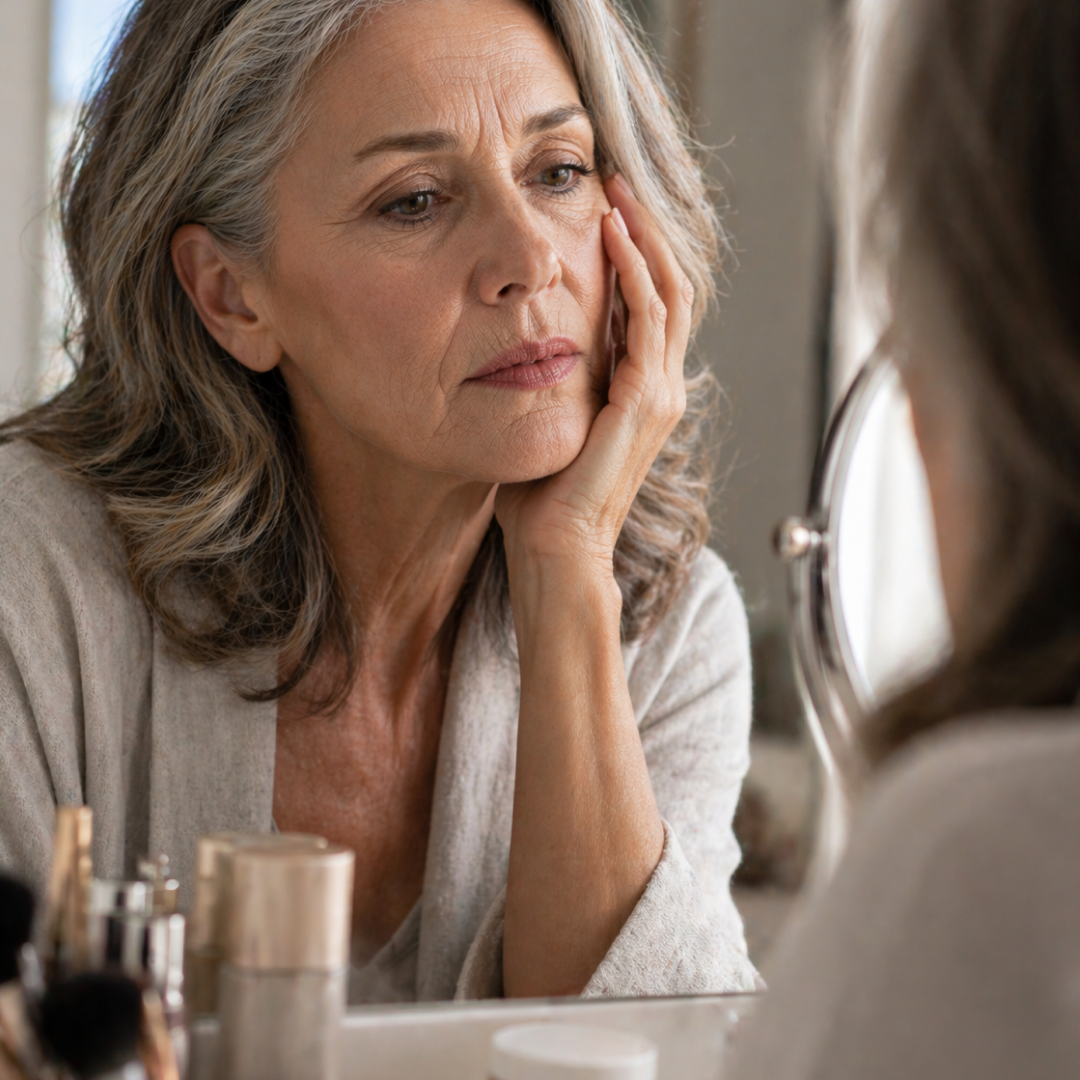
Language shapes how we see the world. It shapes how we see ourselves. When the beauty industry uses "anti-aging" as a selling point, it makes an implicit argument: aging is something to be fought. That the way your face looks at 55 is a problem to be solved, not a chapter of life to be acknowledged.


Every serum that promises to "reverse the signs of aging." Every moisturizer that claims to "turn back the clock." Every before-and-after campaign that shows a woman looking younger as the goal. They're all sending the same message: the way you look right now isn't good enough. It's a powerful commercial motivator. It's also built on a false premise.


And it lands differently on women than it does on men. Men with silver hair and lined faces appear in campaigns as aspirational figures: distinguished, seasoned, full of character. Women with silver hair and lined faces are handed eye cream and told their skin is "showing signs of aging," as though the signs of a life lived fully are something to be ashamed of.


Women 40, 50, 60 and older have lived entire lives. They've built careers, navigated loss and joy, learned things that only decades can teach. Their faces reflect that. That's not a flaw. That's evidence.

The $60 Billion Problem

The global anti-aging market is worth over $60 billion and growing. It's one of the most profitable segments in beauty, not because anti-aging products work better than anything else, but because the category taps into something more powerful than efficacy: fear.


The fear of becoming invisible. The fear of being seen as past your prime. The fear, specific to women, of being defined primarily by how young or old their face looks.


Brands that use anti-aging language aren't just selling products. They're selling the belief that aging is a problem. Because if you believe that, you'll keep buying.


Boom was built on the refusal to participate in that model.
Where Pro-Age Came From

Cindy Joseph was in her 40s, silver-haired, walking down a New York street when a modeling scout stopped her and asked if she was interested in a cover shot-campaign. She had spent decades as a makeup artist for the beauty industry. She knew it from the inside: what was claimed, what was true, how products were marketed.


Now, for the first time, she was on the other side: being celebrated for looking exactly her age. It struck her as remarkable that this was remarkable.


She started asking a question the industry wasn't asking: what would beauty look like if it started from the idea that women are already enough? Not a younger version of themselves. The woman they are right now, with the face they have today?


The answer was Boom Beauty. Founded in 2010, built on a single conviction: aging is not the enemy. The Pro-Age movement isn't a marketing position. It's the reason Boom exists.

Pro-Age vs. Anti-Aging: What the Difference Actually Means

The distinction between Pro-Age and anti-aging isn't just semantics. It changes what products get made, how they're sold, and who the customer is understood to be.


Anti-aging brands measure success by how young a customer looks after using their product. Pro-Age measures success differently: does this product work beautifully for who you actually are? In practice, that means: Formulas built for mature skin. Not formulas designed to make mature skin look like it did in someone's 30s. Boom's ingredient lists are short and honest. Every ingredient is there for a specific reason.


Photography that features real women at their real ages, without heavy retouching designed to smooth away what decades look like. When Boom photographs a 62-year-old, she looks 62.


Language that treats customers as adults who know themselves. Not targets who need to be convinced they have a problem. A product line that doesn't include anything claiming to erase wrinkles, because we don't believe wrinkles are the problem.

What Women 40 and Over Actually Want

The women who come to Boom have usually spent years navigating a beauty industry that wasn't quite built for them. They know the tricks: the products that promise more than they deliver, the campaigns that use 25-year-old models to sell moisturizer to 55-year-olds, the language designed to make them feel like a before photo waiting for an after.


They're over it.


What they want is straightforward: products that work to support their skin. Brands that communicate honestly. A beauty experience that doesn't start from the premise that they need to be fixed.


They're not looking to look younger. They're looking to look like themselves: well-rested, healthy, put-together. There is a meaningful difference, and the industry has been slow to recognize it.

The Cultural Moment

Pro-age beauty is gaining visibility, not because the idea is new, but because the market is finally catching up with the demographic. Women over 40 are one of the largest and most extraordinary markets in the world.


For decades, the beauty industry treated them as an afterthought, a segment to be managed with "anti-aging" products while the aspirational imagery stayed young.


That's beginning to change. More brands are featuring women over 50 in campaigns. The conversation about age-positive beauty has moved from niche to mainstream. But much of this progress is surface-level. A campaign featuring an older woman with heavily retouched skin is not Pro-Age beauty. It's Pro-Age marketing with the same anti-aging product underneath.


Real change means rethinking what products are made and what claims are attached to them. Boom has been doing that since 2010. We didn't pivot to Pro-Age when it became commercially interesting. We were built on it.

Common Questions About Pro-Age Beauty

  • What does "Pro-Age" mean?

    Pro-Age is a philosophy that treats aging as a natural, positive part of life rather than a problem to be solved. In beauty, it means making products designed to work with who you are now. Not to make you look like a younger version of yourself. The term was popularized by Cindy Joseph, who founded Boom Beauty in 2010.

  • What's the difference between Pro-Age and "aging gracefully"?

    "Aging gracefully" still frames aging as something to be managed, just more elegantly. Pro-Age removes the judgment entirely. Aging isn't graceful or ungraceful. It's life. Pro-Age beauty starts from that premise.

  • Are Pro-Age products different from anti-aging products?

    Often, yes. Pro-Age products are formulated for how mature skin actually behaves: drier, with different texture, different hydration needs. Rather than being designed to make mature skin look younger. Claims are specific and honest rather than aspirational.

  • Who is Boom Beauty for?

    Boom Beauty is made for women 40 and older who are done apologizing for their age and done with a beauty industry that asks them to. Our customers know what they want, they know their skin, and they're looking for products and a brand that meet them where they are.

Shop Boom Beauty

CHECK OUT OUR MOST POPULAR CONTENT

4 All Natural Ingredients Your Skin Will Love
5 Makeup Tips for Older Women

How to Shift Your Perspective on Aging
How to Make the Switch to All Natural Skincare
6 Tips for Taking Amazing Photos and Videos
Create Your Own Spa at Home
3 Things Every Woman Needs to Hear About Aging, Beauty and Life
4 Tips for Overcoming Perfectionism

May 06, 2026

Sign Up For Our Newsletter

Plus, be the first to know about exclusive deals, news, and launches.

Shop

  • Shop All
  • Best Sellers
  • New
  • Boomsticks
  • Heritage Boomsticks
  • Skincare
  • Makeup

About

  • About Us
  • Our Founder
  • Boom Better Beauty Standards

Help

  • Returns
  • FAQ
  • Blog
  • Contact Us

Sign Up For Our Newsletter

Plus, be the first to know about exclusive deals, news, and launches.

  • Facebook
  • Instagram
  • TikTok
  • YouTube
  • Follow us on social media!
© 2026, BOOM! Beauty. All rights reserved.
  • POS and Ecommerce by Shopify
  • Privacy Policy
  • Terms of Use
  • Accessibility
Country/region
  • United States (USD $)
  • Afghanistan (USD $)
  • Åland Islands (USD $)
  • Albania (USD $)
  • Algeria (USD $)
  • Andorra (USD $)
  • Angola (USD $)
  • Anguilla (USD $)
  • Antigua & Barbuda (USD $)
  • Argentina (USD $)
  • Armenia (USD $)
  • Aruba (USD $)
  • Australia (AUD $)
  • Austria (USD $)
  • Azerbaijan (USD $)
  • Bahamas (USD $)
  • Bahrain (USD $)
  • Bangladesh (USD $)
  • Barbados (USD $)
  • Belarus (USD $)
  • Belgium (USD $)
  • Belize (USD $)
  • Benin (USD $)
  • Bhutan (USD $)
  • Bosnia & Herzegovina (USD $)
  • Botswana (USD $)
  • Brazil (USD $)
  • British Virgin Islands (USD $)
  • Bulgaria (USD $)
  • Burkina Faso (USD $)
  • Burundi (USD $)
  • Cambodia (USD $)
  • Cameroon (USD $)
  • Canada (CAD $)
  • Cape Verde (USD $)
  • Caribbean Netherlands (USD $)
  • Central African Republic (USD $)
  • Chile (USD $)
  • China (USD $)
  • Colombia (USD $)
  • Comoros (USD $)
  • Côte d’Ivoire (USD $)
  • Croatia (USD $)
  • Cyprus (USD $)
  • Czechia (USD $)
  • Denmark (USD $)
  • Djibouti (USD $)
  • Dominica (USD $)
  • Dominican Republic (USD $)
  • Egypt (USD $)
  • El Salvador (USD $)
  • Equatorial Guinea (USD $)
  • Estonia (USD $)
  • Eswatini (USD $)
  • Ethiopia (USD $)
  • Faroe Islands (USD $)
  • Fiji (USD $)
  • Finland (USD $)
  • France (USD $)
  • French Guiana (USD $)
  • Gabon (USD $)
  • Georgia (USD $)
  • Germany (USD $)
  • Ghana (USD $)
  • Gibraltar (USD $)
  • Greece (USD $)
  • Greenland (USD $)
  • Grenada (USD $)
  • Guatemala (USD $)
  • Guernsey (USD $)
  • Haiti (USD $)
  • Hong Kong SAR (USD $)
  • Hungary (USD $)
  • Iceland (USD $)
  • India (USD $)
  • Indonesia (USD $)
  • Iraq (USD $)
  • Ireland (USD $)
  • Isle of Man (USD $)
  • Israel (USD $)
  • Italy (USD $)
  • Jamaica (USD $)
  • Japan (USD $)
  • Jersey (USD $)
  • Jordan (USD $)
  • Kazakhstan (USD $)
  • Kenya (USD $)
  • Kiribati (USD $)
  • Kosovo (USD $)
  • Kyrgyzstan (USD $)
  • Latvia (USD $)
  • Lebanon (USD $)
  • Lesotho (USD $)
  • Liberia (USD $)
  • Liechtenstein (USD $)
  • Lithuania (USD $)
  • Luxembourg (USD $)
  • Macao SAR (USD $)
  • Madagascar (USD $)
  • Malawi (USD $)
  • Malaysia (USD $)
  • Mali (USD $)
  • Malta (USD $)
  • Mauritania (USD $)
  • Mauritius (USD $)
  • Mayotte (USD $)
  • Mexico (USD $)
  • Moldova (USD $)
  • Monaco (USD $)
  • Mongolia (USD $)
  • Montenegro (USD $)
  • Montserrat (USD $)
  • Morocco (USD $)
  • Mozambique (USD $)
  • Namibia (USD $)
  • Nepal (USD $)
  • Netherlands (USD $)
  • New Caledonia (USD $)
  • New Zealand (USD $)
  • Nicaragua (USD $)
  • Niger (USD $)
  • Nigeria (USD $)
  • North Macedonia (USD $)
  • Norway (USD $)
  • Oman (USD $)
  • Pakistan (USD $)
  • Panama (USD $)
  • Papua New Guinea (USD $)
  • Peru (USD $)
  • Philippines (USD $)
  • Poland (USD $)
  • Portugal (USD $)
  • Qatar (USD $)
  • Réunion (USD $)
  • Romania (USD $)
  • Russia (USD $)
  • San Marino (USD $)
  • São Tomé & Príncipe (USD $)
  • Saudi Arabia (USD $)
  • Senegal (USD $)
  • Serbia (USD $)
  • Seychelles (USD $)
  • Singapore (USD $)
  • Slovakia (USD $)
  • Slovenia (USD $)
  • South Africa (USD $)
  • South Korea (USD $)
  • Spain (USD $)
  • Sri Lanka (USD $)
  • St. Barthélemy (USD $)
  • St. Kitts & Nevis (USD $)
  • St. Lucia (USD $)
  • St. Martin (USD $)
  • St. Vincent & Grenadines (USD $)
  • Sudan (USD $)
  • Suriname (USD $)
  • Svalbard & Jan Mayen (USD $)
  • Sweden (USD $)
  • Switzerland (USD $)
  • Taiwan (USD $)
  • Tanzania (USD $)
  • Thailand (USD $)
  • Togo (USD $)
  • Tonga (USD $)
  • Trinidad & Tobago (USD $)
  • Tunisia (USD $)
  • Türkiye (USD $)
  • Turks & Caicos Islands (USD $)
  • Ukraine (USD $)
  • United Arab Emirates (USD $)
  • United Kingdom (GBP £)
  • Vanuatu (USD $)
  • Vietnam (USD $)
  • Wallis & Futuna (USD $)
  • Zambia (USD $)
  • Choosing a selection results in a full page refresh.
Item Added to cart
  •  
  •  
One or more of the items in your cart is a deferred, subscription, or recurring purchase. By continuing, I agree to the cancellation policy and authorize you to charge my payment method at the prices, frequency and dates listed on this page until my order is fulfilled or I cancel, if permitted.